
Central chapel and apse
Central chapel and apse
Central chapel and apse
Audio transcription
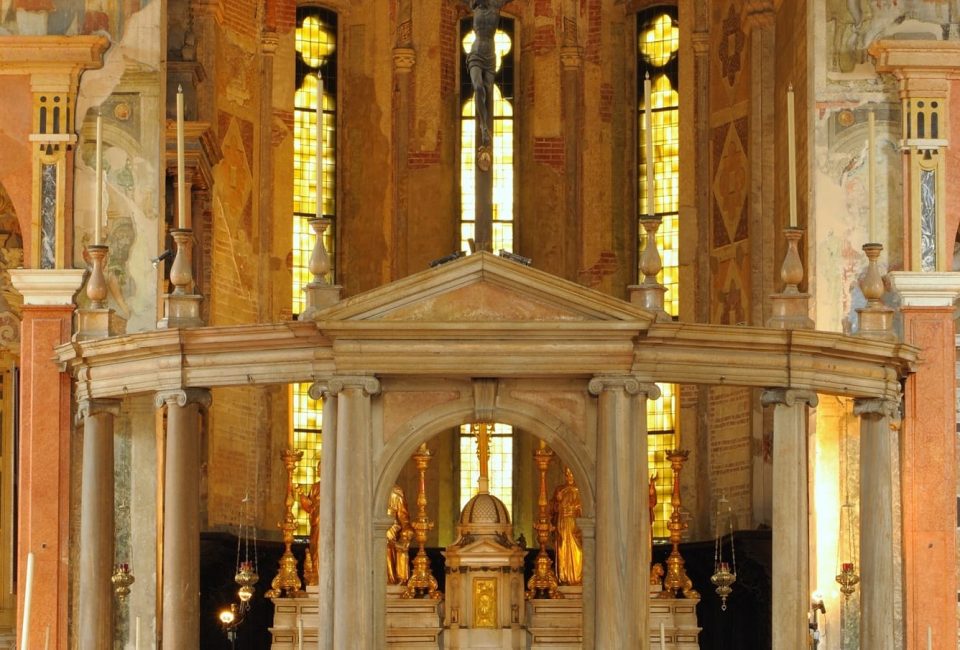
This space, like a treasure chest of priceless art, houses the altar where the relics of Saints Fermo and Rustico are now kept. The semicircular structure, built in 1573, was inspired by the tornacoro – the curved choir screen designed by Michele Sanmicheli in Verona Cathedral – and features multicoloured marble columns.
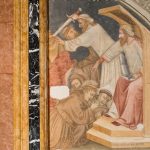
The main arch, which frames the apse area, features fourteenth-century frescoes. At the top, God the Father is shown with his hand raised in blessing; just below, on the left, is a portrait of Prior Daniele Gusmerio, kneeling and wearing a Franciscan habit, while on the right of the arch is the Guglielmo da Castelbarco, the city’s podestà, or governor, and advisor to Cangrande della Scala. He is elegantly dressed and holds a model of a church in his hands, emphasising his role as financial backer of the renovation project of the church of San Fermo. To his right we see the coat of arms of the Castelbarco family. The date 1314, painted on the arch, confirms that these portraits were painted during their lifetimes. Below, on the left, we find The Coronation of the Virgin and, on the right, The Adoration of the Magi, attributed to Paolo Veneziano. The apse vaults are decorated with a cycle of frescoes on a blue background, in the Franciscan tradition, attributed to the Master of the Redeemer. This fourteenth-century master excelled here, bringing the influence of Giotto’s painting to Verona and presenting a vision of Christ the Redeemer in the centre, dressed in brown and with a reddish cloak, characterised by a haloed head with short blond hair and beard, seated in a pose of judgment on a low throne, his gaze fixed forward, his right hand raised in blessing and the other closed, holding a book. On the left, he is flanked by the Virgin Mary dressed in white and on the right by Saint John the Baptist. In the crossing of the vault above them, sealing the sacred story, are the four symbols of the evangelists: the angel for Saint Matthew, the ox for Saint Luke, the eagle for Saint John and the lion for Saint Mark.