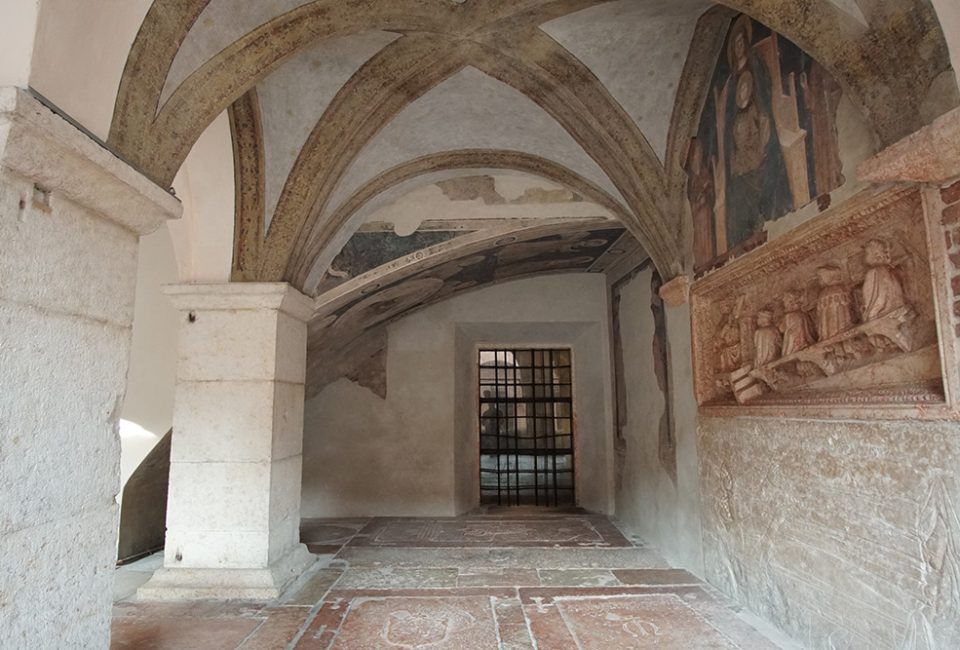
We are in the oldest cloister of the San Fermo complex. The floor features several tombstones with coats of arms, along with fragments of wall paintings, evidence that the cloister was used as a cemetery in the early 1300s.
In the corner leading to the lower church, you will find a unique funerary monument with the tombstone of Omobono, a philosopher and physician depicted in academic garb comparing two texts. Beneath the stairs lies the funeral monument of Antonio Pelacani, a doctor and philosopher who lived during Dante’s time and frequented the same cultural circles in Verona. The marble relief shows Pelacani dressed as a teacher, lecturing four attentive students with open books. Near the exit gate of the cloister, on the right, there are two recently restored sarcophagi: one belonging to the Della Torre family and the other to the Bevilacqua Lazise family. The latter comes from the upper church, where there was once the family chapel of the same name, which contained Paolo Veronese’s Bevilacqua Lazise altarpiece, now in the Museo di Castelvecchio.