

The Lower Church
The lower church
The lower church
Audio transcription
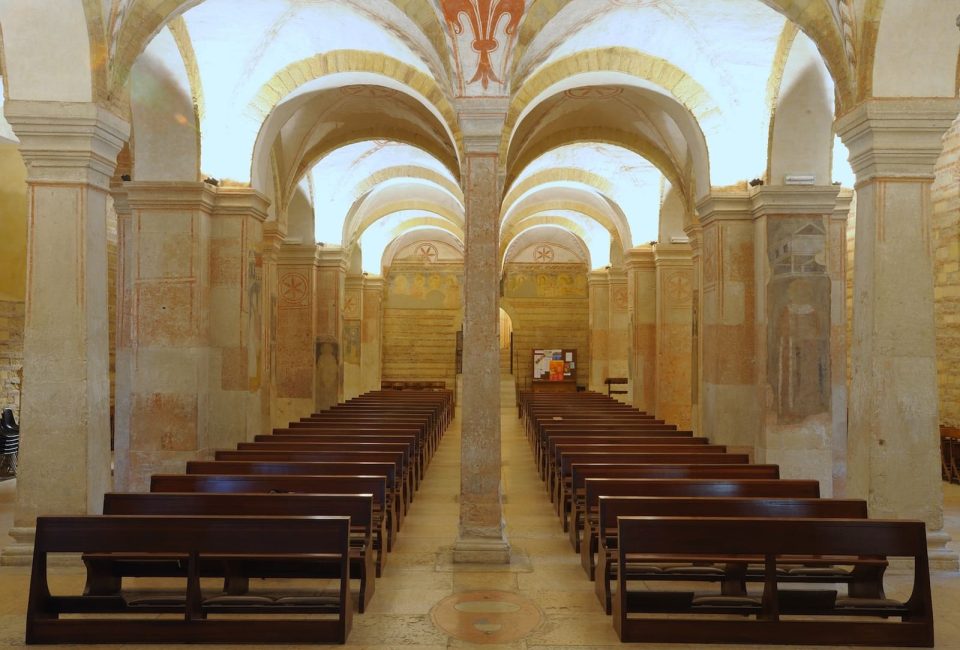
As you go down the impressive double staircase you have a wonderful view of the lower church. The Romanesque setting has been preserved, according to a Clunaic model, with a Latin cross floor plan and three naves, divided further by a row of the central pillars needed to support the weight of the upper church. Enclosed by three apses, the lower church is now visible from the outside thanks to the razing of the surrounding village, which was carried out in 1900 by the architect Antonio Da Lisca.
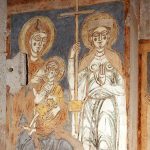
All that remains of the original Benedictine layout are the vaults, the partitioning of the nave, parts of the staircase and window systems, and some of the decorative system, which is one of the oldest pictorial testimonies of the entire complex. In 2005, with the restoration of the rib vaults, early Benedictine ornaments reappeared, such as those in red ochre lines, with “a flower of six petals” inscribed in a circle, which was used by Christians as a symbol of the Risen Christ. It was used to invoke protective power, its configuration being derived from a Christogram from the Greek letters, X and P, which are the initials of the word “Christ.” In the middle, above the door, is the Agnus Dei with the symbols of the passion. To the left are the Baptist and Christ, as well as Mary and St. Firmus. To the right are three angels and St. Rusticus. The fresco is from circa 1150 AD. One of the oldest portraits of St. Francis in all of art history can be seen on the first pillar from the left as you go down the central staircase. It is ascribed to the Minor Friars of the 14th century. Upon entering the church you will notice that all the pillars and columns are painted with frescoes. Those on the left side are among the oldest. On the second pillar one notices an Annunciation, and St. Jerome in the Desert with a Lion, from the mid-twelfth century.