
Introduction
Introduction
Audio transcription
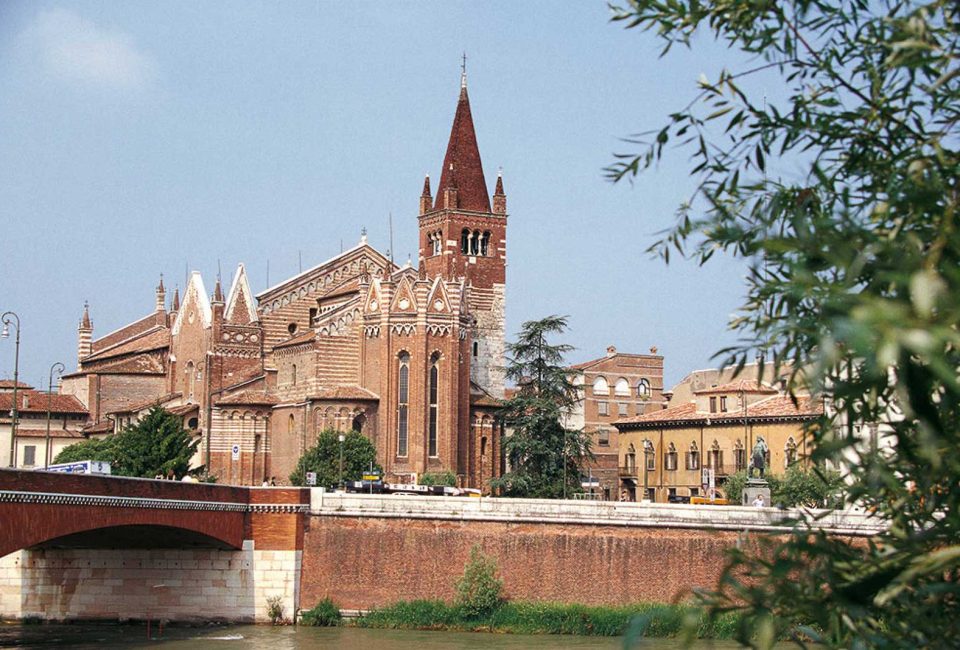
Welcome to the church of San Fermo! Thanks to your help, these extraordinary spaces remain open to the public, protected and periodically restored so they can be preserved for future generations. We’ll begin our visit by heading left, toward the lower church.
In AD 304, Fermo and Rustico, two young converts to Christianity, were beheaded on the orders of the Roman emperor, who had recently launched a brutal campaign of persecution against Christians, which came just a decade before the Edict of Constantine, the proclamation that granted religious freedom across the Empire. A church was built in their honour not far from the riverbank in the fifth or sixth century, and their remains were interred here. In the centuries that followed, the relics were stolen, only to be rediscovered in Istria by Bishop Annone, who paid a fortune to reclaim them and return them to Verona. Before descending into the lower church, take a look at the three wooden models illustrating the various stages of development of this extraordinary complex. The Benedictine monks who had been entrusted with the relics of Fermo and Rustico founded a monastery here and in 1065 began renovating the church. Repeated flooding of the Adige River had resulted in the level of the surrounding village being raised, burying the original church. The early Christian building was demolished to make way for two Romanesque churches, connected by a system of internal staircases. In 1261, the Benedictines were replaced by Franciscan friars, who transformed the upper church into a Gothic structure with a single elongated nave, shaping the church into the structure we recognise today. From the window, you can see a second cloister, once part of the San Fermo complex, but became state property following the suppression of religious orders by Napoleon during the French occupation. Before heading down, take a moment to view the photographic reproduction on the wall; it shows the bronze portal, a modern work by Luciano Minguzzi that currently decorates the façade, with scenes from the martyrdom of Saints Fermo and Rustico and the recovery of their relics: you can admire it up close at the end of your visit. Let us now descend into the oldest part of the complex.